



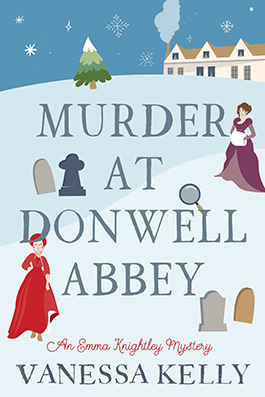
COMING NOVEMBER 24, 2026!
Book Three in the Emma Knightley Mysteries
When Jane Austen’s Regency-era heroine Emma Knightley visits her pregnant friend Jane and her husband Frank Churchill at their Yorkshire estate, a proper country house party soon becomes the site of a ghastly murder . . .
Emma, her husband George, and her father and his new wife have journeyed to Enscombe Park, the grand estate where Jane and Frank live with his uncle, who adopted Frank as a boy. Upon their arrival, they are concerned to find Jane wan from her condition, Frank bruised from a mysterious accident, and Mr. Churchill in an ill temper, as well as surprised by additional houseguests including Miss Caroline Bingley and a distant cousin from the West Indies.
Emma worries this might all be too much for Jane, but it is Mr. Churchill who is decidedly out-of-sorts, possibly due to his heart medication. When Frank’s uncle is found dead in the library, it appears he’s fallen victim to heart seizure. But Emma—despite George’s admonitions to stay out of it—begins to wonder if he may have been poisoned.
Experience has taught Emma that her matchmaking instincts may not always be spot-on, but her sleuthing skills are as sharp as ever. As a recently altered will and secret debts come to light, suspicion falls on Frank Churchill of all people. Now it’s up to Emma to save her friend’s husband from the gallows . . .


The trade paperback is out Oct 27th! Preorder it here.
AVAILABLE NOW!
Book Two in the Emma Knightley Mysteries
In this latest Regency-era mystery, Jane Austen’s clever Emma Knightley navigates shocking changes in her family—while meeting her match in a deadly adversary . . .
Emma’s spirits are elevated after she and husband George Knightley host a joyful holiday celebration at the Hartfield estate. But it’s instantly a bitter January when her father makes an unexpected announcement—he and Miss Hetty Bates have decided to marry. Not only must Emma relinquish her role as mistress of the household, but also accept the reality that the excitable Miss Bates will become her stepmother . . .
More unwanted news arrives during an extravagant betrothal ball at Donwell Abbey, the grand Knightley estate where Emma and George will soon permanently reside. Nearly every villager in Highbury revels in the dazzling affair—except Emma’s hardworking lady’s maid, Prudence Parr. To Emma’s horror, Prudence is found dead, sprawled across the stones of the library terrace . . .
The woman’s tragic fall is quickly ruled a terrible accident and whispers circulate around personal troubles leading up to her untimely demise. But Emma’s instincts tell her that something far more sinister is at play. Now, Highbury’s matchmaker-turned-sleuth vows to outwit a cunning criminal before an innocent man loses his freedom—or Donwell Abbey plunges into a darker mystery . . .
“Murder and mayhem in Jane Austen's world...Plenty of interesting Austen-inspired characters make for a charming read.” ~Kirkus
“A joyous read for an Austen fan - Emma and Miss Bates are the detective duo you didn't know you needed in your life.” ~Julia Golding, author of the Regency Secrets series
Welcome!
Welcome to the website of USA Today bestselling author Vanessa Kelly. You can learn more about Vanessa’s historical mystery series, as well as her historical romances, on this site!
**NEWS FLASH**
MURDER IN HIGHBURY, the first Emma Knightley Mystery, will be released in print and digital on Oct. 22nd, 2024. For more information, please visit the Book Page on the website.
THE HIGHLANDER’S KILTED BRIDE (Clan Kendrick 6) is now available in digital, print, and audio. The blurb, info, and vendor links can be found on the Book Page.
New! Vanessa now has a Family Tree page which outlines the relationships among her characters and books. Click here for the Family Trees.Vanessa runs a book club on Facebook, devoted to her various series. She also hosts fabulous guest authors and wonderful giveaways. Please click here for more info and to join the group.
Visit Vanessa’s BOOKS page to find out about her other books, including the Clan Kendrick Series.
BE SURE TO SIGN UP FOR VANESSA’S NEWSLETTER FOR ALL THE LATEST NEWS ON HER BOOKS, AND SPECIAL CONTESTS JUST FOR SUBSCRIBERS!